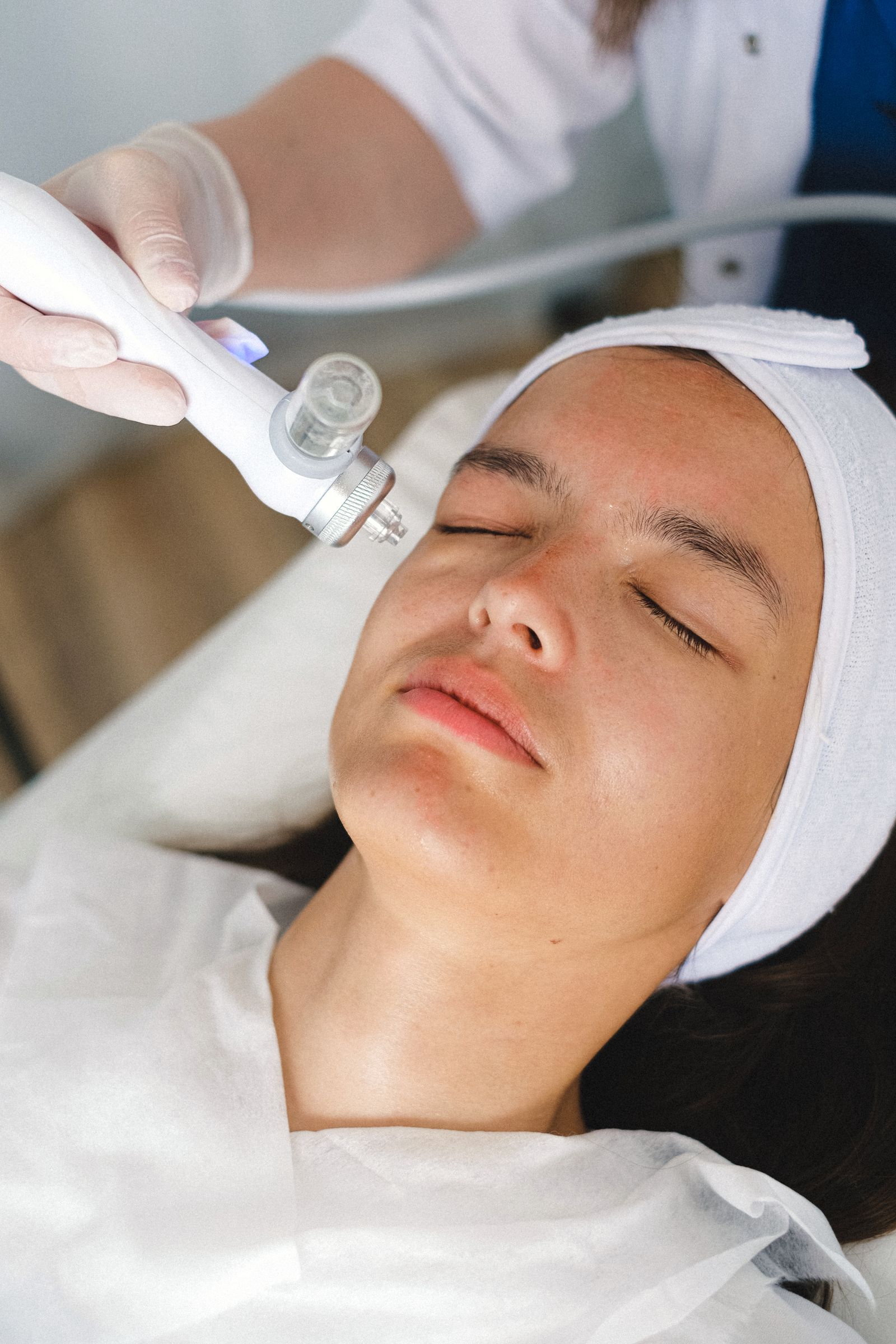
Both traditional microneedling and radiofrequency (RF) microneedling create controlled micro-injuries that stimulate your skin's wound-healing cascade and collagen production. The key difference: RF microneedling delivers bipolar radiofrequency energy through insulated needles at precise depths, heating the dermis to 60–70°C and producing volumetric thermal remodeling. This dual mechanism—mechanical needling plus thermal energy—generates stronger neocollagenesis and elastic fiber reorganization, particularly effective for skin laxity and deep atrophic scarring. Traditional microneedling remains highly effective for fine lines, superficial texture, and early-stage scarring, often with shorter recovery.
How do traditional microneedling and RF microneedling differ in mechanism of action?
Traditional microneedling uses fine needles (typically 0.5–2.5 mm) to create vertical microchannels in the epidermis and papillary dermis. This mechanical disruption triggers the wound-healing cascade, releasing growth factors—TGF-β3, PDGF, VEGF—that drive fibroblast activation and collagen I/III synthesis over 4–6 weeks. Studies show collagen density increases 200–400% after 3–4 monthly sessions, improving fine lines, mild acne scars, and texture.
RF microneedling (devices like Morpheus8, Potenza, Vivace) adds fractional radiofrequency current through insulated needle electrodes. The RF energy heats subdermal tissue to controlled temperatures—60–70°C in the dermis—while the insulated needle shaft protects the epidermis from surface burns. This thermal injury denatures collagen triple helices, triggering immediate contraction and sustained fibroblast-mediated remodeling over 3–6 months. The result: tighter skin architecture, reduced pore size, and improvement in moderate-to-severe laxity that mechanical needling alone cannot achieve. Research published in Lasers in Surgery and Medicine demonstrates RF microneedling produces 3× more collagen deposition than traditional microneedling at equivalent needle depth.
The insulated needle design also allows safe depth penetration up to 4–8 mm (Morpheus8) into subdermal fat, enabling jawline contouring and deeper scar remodeling that traditional microneedling—limited to 2.5 mm and superficial papillary dermis—cannot reach.
What conditions does each treatment address best?
Traditional microneedling excels for superficial concerns: fine lines, mild acne scars (boxcar, rolling), enlarged pores, melasma (when combined with topical tyrosinase inhibitors), and general texture refinement. It's effective for early photoaging and PIH (post-inflammatory hyperpigmentation). We see consistent results in patients seeking Fitzpatrick I–VI improvement for mild-to-moderate textural concerns. Because it induces minimal thermal injury, traditional microneedling carries lower risk of PIH in darker skin tones when performed with appropriate depth and technique.
RF microneedling targets moderate-to-severe laxity, deep atrophic acne scars (ice-pick, boxcar with significant depth), striae distensae (stretch marks), and skin tightening on the neck, jowls, and lower face. The volumetric heating produces adipose remodeling and fibrous septae contraction—particularly useful for body applications (abdomen, thighs) where traditional microneedling has limited effect. A 2019 study in Aesthetic Surgery Journal showed RF microneedling improved moderate acne scarring by 50–75% after three sessions, compared to 30–40% with traditional microneedling.
RF microneedling also addresses subdermal concerns: jawline definition, nasolabial fold depth, and neck crepiness—areas where mechanical needling alone delivers modest improvement. For patients over 40 with visible jowling or mid-face volume loss, RF microneedling provides non-surgical tightening comparable to early-stage thread lifts, though with slower onset (peak results at 3–6 months vs 1–2 weeks).
How do downtime, session count, and cost compare?
Traditional microneedling typically requires 3–6 sessions spaced 4–6 weeks apart. Immediate erythema resolves within 24–48 hours; pinpoint bleeding is rare at depths below 1.5 mm. Most patients return to work the next day with mineral makeup. Cost ranges $300–$600 per session depending on treatment area and device (SkinPen, Rejuvapen). Total investment: $900–$3,600 for a full series.
RF microneedling requires 1–3 sessions spaced 4–8 weeks apart due to more aggressive remodeling. Downtime extends to 3–5 days with visible erythema, mild edema, and occasional pinpoint crusting if depth exceeds 3 mm. Deeper passes (Morpheus8 at 4+ mm for submental tightening) may produce 5–7 days of social downtime. Cost per session: $1,200–$2,500 depending on treatment area, device, and depth. Full series: $2,400–$5,000.
The trade-off: RF microneedling delivers more dramatic single-session improvement, reducing total session count. For patients prioritizing rapid results with tolerance for longer recovery, RF microneedling is cost-effective per unit of collagen remodeling. For those seeking gentler, cumulative improvement with minimal downtime, traditional microneedling over 4–6 months remains ideal.
Who is a candidate for each treatment, and can you combine them?
Traditional microneedling suits patients with Fitzpatrick I–VI skin, mild-to-moderate concerns, limited downtime tolerance, and budget under $1,000 per area. Contraindications: active acne, keloid history, anticoagulation, recent isotretinoin (within 6 months).
RF microneedling candidates: moderate-to-severe laxity, deep scars, realistic expectations for 3–6 month collagen maturation, ability to tolerate 3–5 days downtime. Darker skin tones (Fitzpatrick IV–VI) require careful energy titration. Studies show RF microneedling is safe in skin of color when using insulated needles, lower energy settings (15–25 W vs 30–40 W), and strict sun avoidance, though PIH risk increases above 30 W in Fitzpatrick V–VI.
Combining both: We layer traditional microneedling between RF sessions to accelerate superficial texture refinement while deeper thermal remodeling continues. Example protocol: RF microneedling at months 0, 2, 4; traditional microneedling at months 1, 3, 5. This staged approach maximizes collagen density across multiple dermal layers, particularly effective for complex acne scarring with both superficial rolling scars and deep boxcar/ice-pick defects.
How do you match treatment to specific concerns?
For fine lines and early photoaging (age 30–45, minimal laxity): Traditional microneedling 1.0–1.5 mm depth, 4 sessions. Add growth factor serums or exosomes post-procedure.
For moderate acne scars (rolling, shallow boxcar): Traditional microneedling 1.5–2.0 mm, 4–6 sessions. Consider PRP (platelet-rich plasma) overlay to enhance fibroblast activation.
For deep acne scars (ice-pick, deep boxcar) or significant textural irregularity: RF microneedling 2.5–4.0 mm, 2–3 sessions. Target scar periphery with higher energy (25–30 W) to release fibrotic tethering.
For skin laxity (jowls, neck, nasolabial folds) without surgical indication: RF microneedling 3.0–8.0 mm (Morpheus8 or Profound RF), 1–2 sessions. Expect 20–30% skin contraction, peak at 6 months.
For melasma or PIH in darker skin: Traditional microneedling 0.5–1.0 mm with tyrosinase inhibitors (tranexamic acid, kojic acid). Avoid RF microneedling or use minimal energy (<20 W) to prevent rebound hyperpigmentation.
For body concerns (stretch marks, abdominal laxity): RF microneedling 3.5–6.0 mm, 2–3 sessions. Traditional microneedling has limited efficacy on thick body skin.
This decision tree reflects mechanism-matched treatment: superficial texture responds to mechanical needling; volumetric laxity requires thermal remodeling. Matching depth, energy, and session cadence to histologic targets ensures efficient outcomes and minimizes unnecessary cost or downtime.